Crisis of Meaning
These days, wherever I look, I see relationships and families coming undone, people spiralling into anger or depression, unsure what to do or how to resolve the issues that plague them. After 35+ years of accompanying lives from many parts of the world through my work as a psychotherapist, one thing comes into focus for me ever more clearly: most people have lost any sustaining frame of reference for the purpose and meaning of life.
A young married couple live on the roller-coaster of fights, reconciliation, more fights, thoughts of divorce, and utter perplexity as to why things are not working and there is so much pain. A mother is flying across Europe to help a gifted daughter in college who cannot find a way to feel grounded. People have no trust in their jobs, fewer and fewer have a sense of value or contribution; it’s mostly a pay check. Politicians continue bickering and playing the postures-and-statements game while the planetary crisis is rapidly approaching its climax, and millions of lives are brutally uprooted and submerged into devastation by proxy wars, indigenous land grabbing, and climate crisis. What is wrong with this picture?
We have a crisis of meaning today that can be solved only through reconnecting to the foundational spiritual principles of life.
Do we not, otherwise, have the knowledge, the scientific expertise, and the collective intelligence to make better systemic decisions for the benefit of humanity and the planet? Of course we do. But motivations have become perverted by overwhelmingly material pursuits, and we cannot seem to take hold of what is the purpose of all our movements, what is the ultimate meaning of all our efforts — so we are blown around by the winds of deepening chaos. Even worse, we are becoming like starved children who are past the point of being able to receive food: We do not even ask fundamental questions anymore. Rather, we just want to see the next immediate strategy, like a game of chess, except the king and the queen are in checkmate.
A fellow writer wrote on Medium: “What do we dedicate the only treasure we have, which is life, to? This is the question before us. It is the great question of this age. And it is left unasked. We are too frightened and scared… What will we dedicate our lives to? The river of love has run dry in our times.” In his words, we are “feasting on a wounded civilisation.”[i] Well said.
A powerful visual illustration of how a dying civilisation feasts on its deepest wounds of objectification of human life can be found in today’s article in The Guardian[ii], as part of reporting on the Met Gala. The theme, Body as Masterpiece: Nipples, Skeletons, and Tatoos Dominate at Record-Breaking Met Gala, is illustrated by the following image:
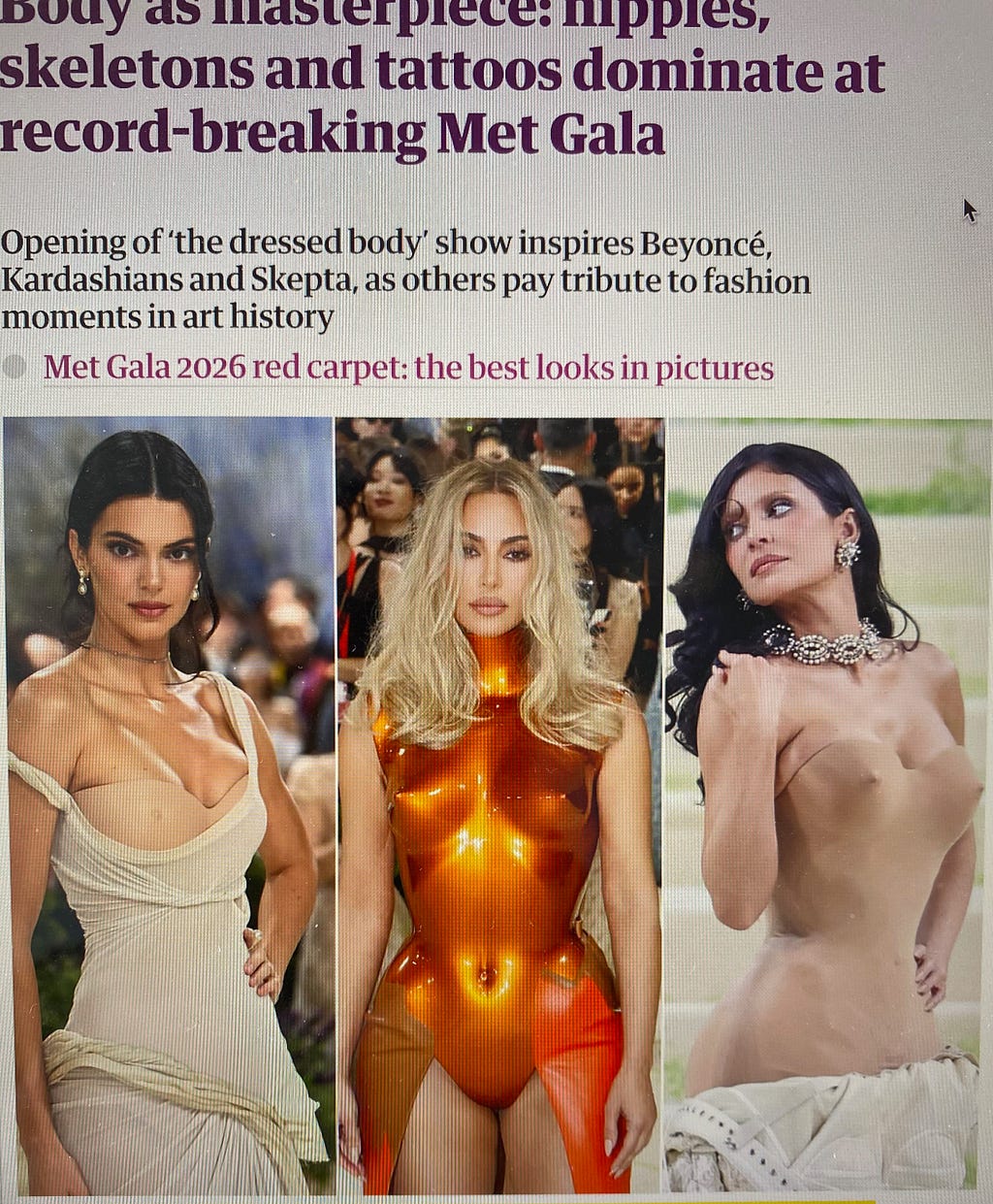
This disturbing view of what is valued in life trickles down into the groups of young people in the parks — guys in black, girls in loose ragged jeans, straightened hair and vaping — empty-eyed and marching into the uniform emptiness, afraid to search deeper.
Another fellow writer on Psychology Today quotes psychiatrist Victor Frankl’s diagnosis of society after World War II as afflicted by the “mass neurotic triad” of aggression, addiction, and depression. As he explores how much each of these have intensified in the decades since, he suggests it is up to each of us to find a meaning that sustains us.[iii]
While what Dr. Marshall calls the “personal operating system that guides the interpretation of experiences and motivations,”[iv] is constructed early in life, and therefore differs for each of us based on worldviews and beliefs we are exposed to, and much psychology teaches how we can open space between our automatic operating system and our actual response, something systemic is missing in these discussions of the crisis of meaning. Frankl himself suggests that in our choice how we respond to circumstances lies our freedom. Even as the behavioural sciences recognise the mediating role of resilience and self-control in subjective wellbeing amidst our general crisis of meaning[v], we still do not seem to understand what sustains our real freedom.
What sustains genuine freedom?
At the core of every world spiritual tradition there lies an understading about the meaning and purpose of life that is greater than the individual life and all its ups and downs. How did we so profoundly lose touch with that foundational education? How did we allow dogmatic religious wars to turn us so completely away from concepts such as human virtue, spiritual growth and service to humanity?
A human being is a configuration of body, mind, soul and spirit in a particular socio-cultural context[vi]. We have education that trains and develops the body, as well as the mind. Cultures, through literature, art, and music, convey in all kinds of explicit and implicit ways their worldview. The one thing we have utterly neglected is spiritual education, one that has a systemic non-denominational, universal foundation. Such education provides a larger frame of reference from which to view and analyze life circumstances, political shenanigans, geopolitical and planetary crises, societal corruption and collapse, as well as personal issues, and to see a meaningful way forward.
Spiritual Frame of Reference
If life is not limited to the material plane, but is essentially consciousness, which evolves, as both advanced science and spiritual traditions maintain, that means that the purpose of life is precisely that evolution toward choices that reveal more truthfulness, more goodness and contribute to more harmony and beauty in the world. That applies individually and collectively. If we just look around and appreciate the extent to which such a frame of reference has been discarded for the sake of short-term gain and impact, there remains no surprise why people are so disheartened, confused, and stuck in make-believe images and postures, while so-called “influencers” and public figures have replaced deep reading and reflection.
When I listen to couples in crisis, I want to say, “Can you see how each of you is reactive, impulsive, self-centred? Does it occur to you that this crisis is not primarily in the relationship, but a crisis of seeing? Of seeing your own self? How much time in a day do you set aside to reflect on your own way of being?”
For all these reasons and many more, when the Covid pandemic paralyzed our lives, I wrote my book on unitive healing, describing many lives and journeys on this path. But one voice is not enough. Nor are several voices. We need to wake up and remember what makes us fundamentally human and alive — the rational faculty of our spirit! No one who has witnessed a person dying can dispute that at the moment of death the familiar body transforms almost instantly into an unrecognisable shell, once spirit is no longer connected to that body. How then can we move through life without consciously and consistently educating our spirits, and holding that as a collective standard for all decisions — and yet expect that things should work out?
The result of defining life through primarily, if not solely material occupations is such a degree of corruption that now shocks and paralyzes most ordinary people. As a fellow Medium writer describes it, “Predatory systems have demoralized and dispirited people to the point that they’re bewildered, lost, and disoriented… What’s the…point? When the most vicious and barbaric seem to get ahead to the point of becoming trillionaires? When our systems reward incompetence, irresponsilbity, malfeasance, with eye-popping sums? When life itself seems like a perpetual struggle, and working hard and playing by the rules gets you less than nowhere? What’s the…point?”[vii]
In response, there are many groups and resources that try to speak to the collective need to reclaim who we are and what life is about. Each emphasises a particular facet of this reality. Some speak of interbeing; others of reclaiming joy; others of processes of unitive justice; yet others on love and compassion; and yet others, on the need for coherent and credible global structures that can balance planetary life. All these are facets of systemic spiritual education that needs to be understood as a coherent universal system — a viable and eternal antidote to our crisis of meaning.
We have to start reading and reflecting again — carefully, systematically, not for entertainment but for meaning. In order to discern the distinctions between the many social and cultural myths that permeate our unconscious approach to life, and the actual spiritual laws that govern life and provide a viable direction. A good and accessible starting point is Some Answered Question[viii], a compilation which examines carefully the evolution of human civilization under the influence of prophetic spiritual figures, the nature of mind, soul, and spirit, and free will in the world of being. Reclaiming our dignity in this way, and the meaning and purpose of existence, is a first step in responding to our current crisis by rising above the current standard of social collapse, and elevating our public discourses to where we can establish a new and coherent standard.
The choice is ours. But not just individually. Even more importantly — collectively.
[i] https://medium.com/eudaimonia-co/how-to-profit-from-a-dying-civilization-4752841455b7
[ii] https://www.theguardian.com/fashion/2026/may/05/body-masterpiece-nipples-skeletons-tattoos-record-breaking-met-gala-beyonce-kardashians
[iii] https://www.psychologytoday.com/us/blog/the-meaningful-life/202510/the-crisis-of-meaning-in-contemporary-society
[iv] https://globalioc.com/making-sense-of-meaning-making/#:~:text=Global%20meaning%20is%20also%20referred,is%20constructed%20early%20in%20life.
[v] https://pmc.ncbi.nlm.nih.gov/articles/PMC7016625/
[vi] Mustakova, E. (2021). Global Unitive Healing: Integral Skills for Personal and Collective Transformation.
[vii] https://medium.com/eudaimonia-co/why-we-all-feel-like-giving-up-and-what-to-do-about-it-3ab10c387fbe
[viii] ‘Abdu’l-Bahá, Some Answered Questions. Wilmette, IL: Bahá’i Publishing Trust, 1964.